

Relative Age Effect (RAE) is the phenomenon where children born earlier in the calendar year have a greater chance of success in sports, especially at younger ages, due to early physical and developmental advantages.
Often ignored or overlooked, the month of the year in which your children are born can impact their sporting progress significantly, especially when they are young. So why does the birth month matter early on?
Physical & Cognitive Development
Kids born earlier in the year are often bigger, stronger and more coordinated than their peers born later in the year – simply because they’ve had more months to develop. This difference can be significant during childhood and adolescence.
Selection Bias in Youth Sport
Coaches and scouts tend to favour more physically developed kids for teams, training camps and competitions. These early advantages in turn lead to better coaching, more competitive opportunities and ultimately greater long-term development.
Confidence & Motivation
Early success builds confidence and motivation encouraging kids to stay in sports and train harder while late bloomers may get discouraged. This is because children born early in the calendar year are likely to get selected to competitive teams, get better training and so on while those born later may get overlooked because they don’t possess powerful physical attributes.
The Relative Age Effect varies significantly across different sports depending on the physical demands, competition structure and talent identification practices. Typically, Relative Age Effect impacts sports that involve physical contact, strength and power along with strict cutoffs based on calendar year age groups (e.g. U10, U12 and so on) far more than others.
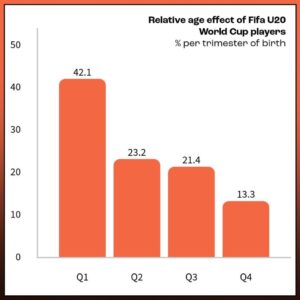
The chart above shows how Relative Age Effect is playing out at the FIFA U20 World Cup currently on in Chile right now and you can see how players born between January and March seem to have an advantage all the way up to U20 level!
It is true that Relative Age Effect does reduce as children move into adulthood, but can you imagine how many talented children get lost along the way because they are “too small” or “too slow”. What if someone had told Messi or Modric they were too tiny? We’d have missed out on seeing two of the best footballers of this generation.
That’s why one of the things we now do to negate Relative Age Effect at Bravo is to separate our competitive groups into single year age bands. For example, in the U10s, we will actually have a U10 squad and a U9 squad, U8s will have a U8 squad and a U7 squad and so on. In addition, at Bravo we focus on nurturing technically sound players who are good on the ball rather than pure athletes who can just run faster, jump higher or kick the ball longer. There’s no doubt that physical attributes and mental maturity matter, but how will we see this in our young children without even giving them a fair chance and judging them by unrealistic standards?
At Bravo, we are in football for the long run. We see it as a marathon rather than a sprint. This means taking losses, playing the “weaker” kids, giving everyone maximum game time, even when most chase meaningless trophies and medals. What good is our training if our children aren’t still enjoying sport as adults or gaining good habits from training? We’d prefer the short-term losses today in exchange for the lifelong win of a child becoming a more confident, responsible and happy adult.
If you would like to help your child enjoy the beautiful game, call us on 9819337766 or 9819227766.
P.S. If we’re talking about being inspired by world champions, none comes close to swimming legend, Michael Phelps! So please watch the documentary about his life below!